Object Status:
Unlocated
Accession Date:
October 1766
Primary Source Reference:
"Catalogue raisonné des morceaux d'Histoire Naturelle que j'ai l'honneur d'envoyer ci-joint à Monsieur du Simitierre," Du Simitière Scraps, Library Company of Philadelphia, no. 50, p. 3
Additional Source Text:
"Je [parvit?] que ce singulier fossile qu'on ne trouve que dans les environs de Coblents est le noyau d'une grande terebratula à lacune et à trois lobes et dont le lacune Sous profundes dont le [bu?] et le coquille ont [péries?], permis no. 47"
Trans.: I [found?] that a singular fossil that is only found in the vicinity of Coblents is the nucleus of a large terebratula with lacuna and has three lobes and whose lacuna [meaning unclear after this point]
Marginal note in Du Simitière's hand: "perdu" (lost)
Notes:
Hysteroliths are also known as woman stones, womb stones, mother stones, or vulva stones (with the scholarly name derived from the same root as “hysteria”). Stephen Jay Gould has written of them: "Hysteroliths are the internal molds of certain brachiopod shells (just as bucardites . . are internal molds of certain clamshells). Brachiopods are not closely related to clams, but they also grow shells made of two convex valves that open on a hinge located at one end of the shell and close by bringing the two valves together all along their edges. Therefore, if you make an internal mold by pouring plaster of paris into the closed shell, the resulting object will look roughly like a flattened sphere, with the degree of flattening specified by the convexity of the shell. Highly convex shells can produce nearly spherical molds (as in the fat clamshells that make bucardites). Shells of lower convexity -- including most brachiopods and all the groups that make hysteroliths -- yield more flattened molds.== Since molds are negative impressions of surrounding shapes, the suggestive parts of hysteroliths record features on the interior of a brachiopod shell in reverse. The slit that suggested a vulva and gave hysteroliths their name marks the negative impression of a raised and narrow linear ridge -- called the median septum -- that runs right down the middle of many brachiopod shell interiors, effectively dividing the valve in half. (For a clarifying analogy, think of the ridge as a knife and the slit as a cut.) The less pronounced 'male' features on the other side of some hysteroliths record, in positive relief, a cylindrical groove on the shell interior that houses part of the feeding skeleton (detached from the shell itself and rarely fossilized) in some groups of brachiopods." "Bacon, Brought Home," Natural History Magazine, 108 (June 1999): 28-33, 72-78 / https://indexarticles.com/reference/natural-history/bacon-brought-home/
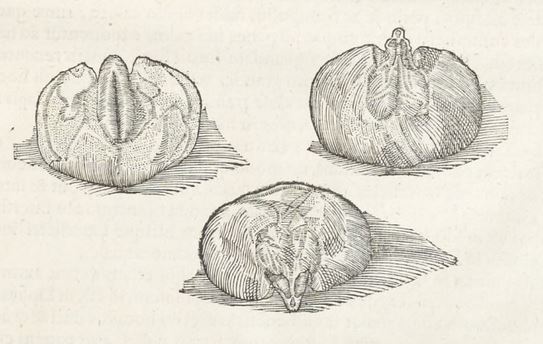
Pictured here is the first drawing of hysteroliths ever published -- by the Danish natural historian Ola Worm in 1665.
The donor was a man named Frey, of Basel, Switzerland. He may have met Du Simitière during miltary campaigns in Flanders. The men corresponded and exchanged natural history specimens in 1765 and 1766. Frey's covering letter for his shipment of fifty fossils and other natural history specimens was dated at Basel, 1 Oct 1766. Du Simitière Papers, Library Company of Philadelphia.