Object Status:
Extant
Accession Date:
By 1799
Primary Source Reference:
Charles Willson Peale, Lecture on Natural History 13. (ca. 1799). Academy of Natural Sciences of Drexel University Archives, coll. 40. / https://ansp.org/research/library/archives/0000-0099/coll0040/
Additional Source Text:
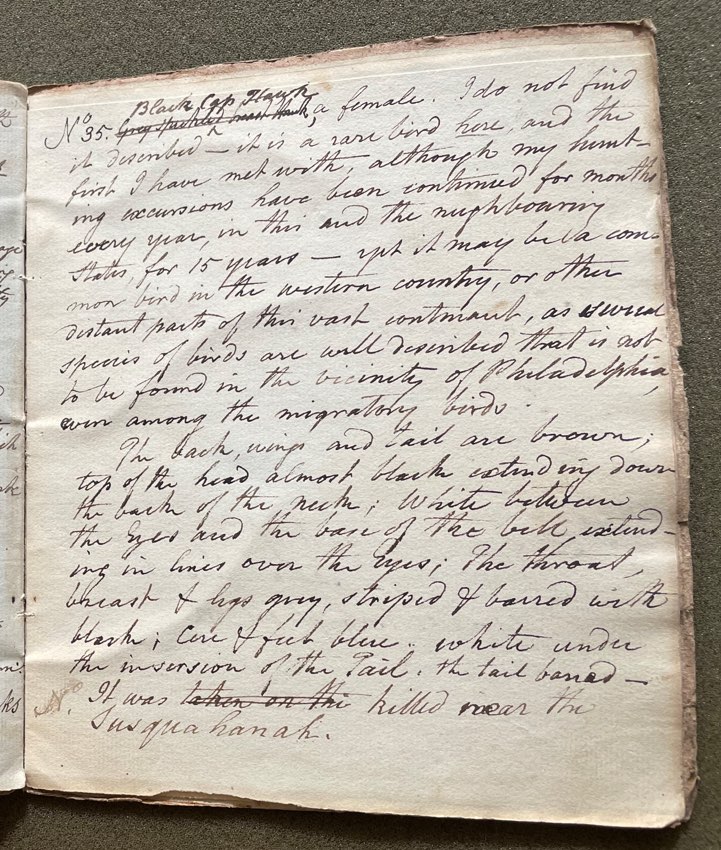
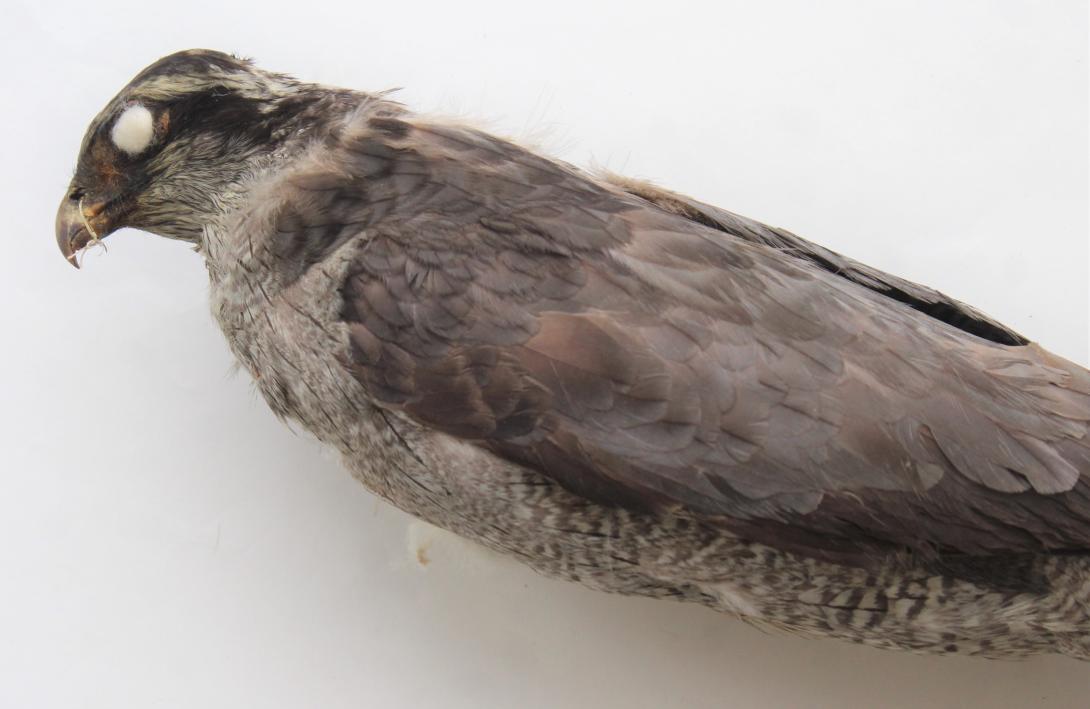
Charles Willson Peale (1741-1827) wrote, in his 13th Lecture (ca. 1799): "No. 35. Grey Speckled […] Hawk Black Cap Hawk, a female. I do not find it described—it is a rare bird here, and the first I have met with, although my hunting excursions have been continued for months every year, in this and the neighboring states, for 15 years. Yet it may be a common bird in the western country, or other distant parts of this vast continant, as several species of birds are well described that is not to be found in the vicinity of Philadelphia, even among the migratory birds. / The back, wings and tail are brown; top of the head almost black extending down the back of the neck; white between the eyes and the base of the [beak], extending in lines over the eyes; the throat, breast & legs grey, striped & barred with black; cere & feet blue; white under the inversion of the tail; the tail barred. It was taken on the killed near the Susquehanna [River]." (Academy of Natural Sciences of Drexel University Archives, coll. 40)
Alexander Wilson (1766-1813) described this species under the name "Ash-colored, or Black-cap Hawk / Falco atricapillus" in American Ornithology vol. 6 (Pl. 52), where "Peale's Museum, No. 406" was cited (Wilson 1812: 80). / https://www.biodiversitylibrary.org/item/175484#page/106/mode/1up (text) / https://www.biodiversitylibrary.org/item/175484#page/100/mode/1up (plate)
Two mounted specimens from France (male and female), identified as "Falco palumbarius. (Goshawk)", were listed in an unpublished "Catalogue of Duplicate specimens..." (1822); no duplicate of F. atricapillus was listed, which implies that Peale's original (Susquehanna) specimen was no longer extant by 1822.
Notes:
Peale’s lecture account was overlooked by Matthew R. Halley, 2022, "Rediscovery of the holotype of the American Goshawk, Accipiter gentilis atricapillus (Wilson, 1812), and a commentary about Alexander Wilson’s contributions to the Peale Museum," Proc. Acad. Nat. Sci. Phila. 167: 171-178, who relocated a specimen of this species (ANSP 1208) “from the Peale Mus.", according to a note that was evidently transcribed from the wooden pedestal (now missing). / https://doi.org/10.1635/053.167.0114
Wilson’s type specimen of “Ash-colored, or Black-cap Hawk / Falco atricapillus” (thought to have been Peale No. 406), which was “shot within a few miles of Philadelphia, [and] is now preserved, in good order, in Mr. Peale’s museum," is thought to have been deposited by him on 30 November 1812, according to a record of his donation of “Several Specimens of Hawks, nondescripts” in the Peale Museum Accessions Book (Historical Society of Pennsylvania, coll. 0481).
Whereas, the specimen described by Peale in his 13th Lecture (ca. 1799) was “killed near the Susquehanna [River]." Wilson was apparently not familiar with Peale’s specimen. / https://doi.org/10.1635/053.167.0114
Specimen Type:
Dead/preserved
Peale's Common Name:
Grey Speckled Hawk / Black Cap hawk
Peale's Scientific Name:
None given
Current Common Name:
American Goshawk
Current Scientific Name
Accipitridae
Accipiter atricapillus
Repository:
Academy of Natural Sciences of Drexel University (ANSP 1208)