Object Status:
Unlocated
Accession Date:
By 1826
Primary Source Reference:
Anne Newport Royall, Sketches of the History, Life, and Manners, in the United States (New Haven, 1826), p. 214
Additional Source Text:
"It is surprising how the mischief and cunning peculiar to the countenance of these animals can be so perfectly retained. One of them had his shoe, (about an inch long,) on his knee, fastened with a strap, under his foot, while he was boring with the awl, the ends in his hands ready to thrust throught the hole, with all the eagerness of a person in a great hurry."
Notes:
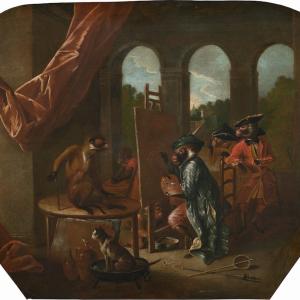
Singerie is a French word for “monkey trick” and is the name given to arts depicting monkeys aping human behavior. Most singerie was in the form of paintings, prints, or interior decoration such as wallpaper and tapestries, but the Peale Museum's display was a three-dimensional model using taxidermied animals.
"In 1809 Mr. Peale commenced a collection of stuffed monkeys, dressed as human beings, and engaged in some of the occupations familiar to man. The first exhibition represented a poet and a painter, with another individual sitting for his portrait in the artists' studio. Others followed, and in each new group some comical effect was obtained. Monkeys were represented as engaged in the various trades, and the contrast between their grave occupations and their mischievous faces and ridiculous attitudes was extremely amusing. Peale's monkey tradesmen live in the memory of many aged Philadelphians." J. Thomas Scharf and Thompson Westcott, in their History of Philadelphia, 1609-1884, 3 vols. (Philadelphia, 1884), 2: 947
Search "singerie" for two other similar displays in the Peale Museum.
Specimen Type:
Dead/preserved