Object Status:
Unlocated
Accession Date:
December 10, 1817
Primary Source Reference:
Peale Museum Accessions Book, Historical Society of Pennsylvania, p. 89
Additional Source Text:
"Found in great abundance on the Potomack River."
Notes:
Pudding stone is a particularly colorful variety of conglomerate.
Architect of the Capitol Benjamin Henry Latrobe wrote to the Commissioners of the Public Buildings on 8 Aug 1815 about the "immense Rocks of Marble, or Limestone Breccia, that is of a stone consisting of fragments of ancient Rocks bound together by a calcareous cement, and thus becoming one solid and uniform (homogeneous) Mass of Marble. . . . The largest Mass of this Kind of Rock is situated on the Maryland side of the Patowmac on land the property of Samuel Clapham, Esqr. It overhangs the River, and would furnish whithout land carriage all the Columns of the Capitol of one block each if required, and of beauty not exceeded in any modern or ancient building." RG 42, National Archives; Latrobe Papers, 3:683-684
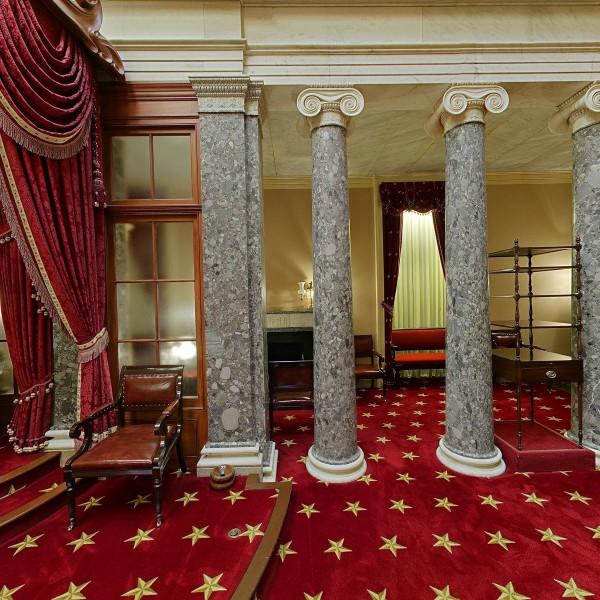
This stone was used for the columns in the House of Representatives and the Old Senate Chamber, pictured here.
On 19 Dec 1817 the Accessions Book recorded the receipt of "Pollished Specimen of the Pudding Stone or Marble from Clapham's Quarry, Maryland (used for the columes in the Senate Chamber, at Washington)" from a Dr. Tebbs (p. 90), and on 22 Sep 1818 the Accessions Book recorded the receipt of "Pollished specimen of the stone used at washington City, to form the Pillars of the Capitol" from John W. McAllister (p. 94).