Object Status:
Unlocated
Accession Date:
March 8, 1802
Primary Source Reference:
(Aurora. General Advertiser (Philadelphia), 8 March 1802
Additional Source Text:
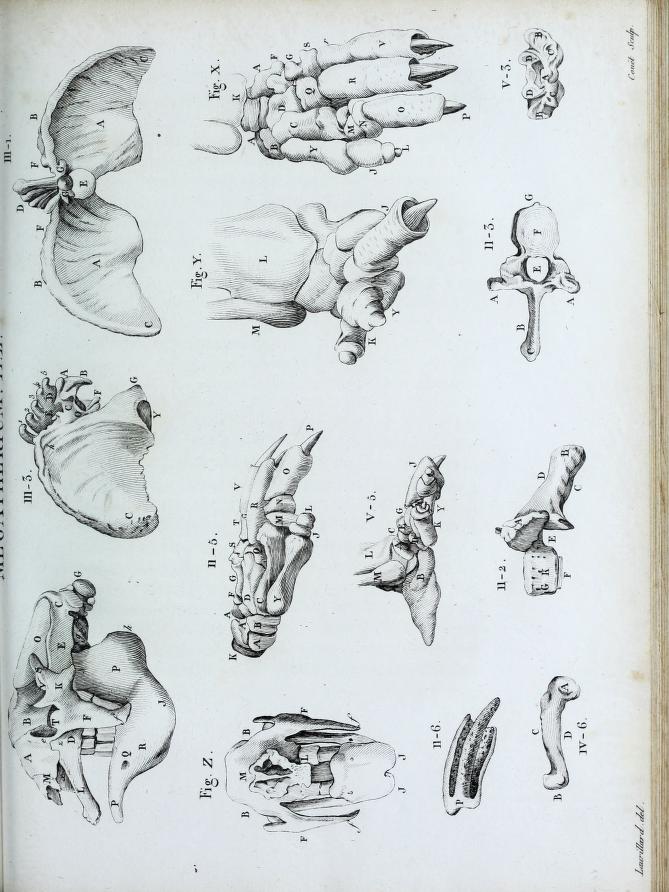
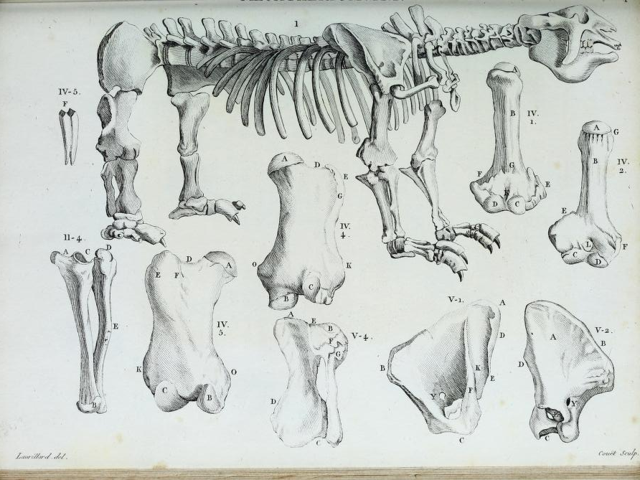
"The engravings, descriptive of that skeleton, are presented to Mr. Peale's Museum by citizen Roume, agent of the French Republic for St. Domingo, and member of the national institut, &c. and are now placed in the room with the skeleton of the Mammoth."
Guide to the Philadelphia Museum (Philadelphia, 1805), p. 7: "In frames hung against the wall, are Engravings of the whole Skeleton and the detached parts, of an unknown Quadruped of the Sloth kind, of great size, found in South America, and now in the Museum at Madrid."
Notes:
The first fossil vertebrate skeleton to be mounted in the world was found in South America about 1788 and shipped to Madrid, where it was mounted in the Royal Cabinet of Natural History by Juan Bautista Bru y Ramon (d. 1799), a Spanish naturalist associated with the museum. Before Bru was able to publish a formal description, Roume sent drawings and a short description to the Institut de France, from which Georges Cuvier (1769-1832) published a memoir in 1796 ("Notes Concerning the Skeleton of a Very Large Species of Quadruped," Monthly Magazine, and British Register, 2 (1796): 637-638 and plate / https://hdl.handle.net/2027/mdp.39015033846026?urlappend=%3Bseq=212%3Bo… ), naming the animal a megatherium and relating it to the sloth.
Roume also provided Peale with engravings of the Madrid skeleton, which were exhibited with the mastodon. Those engravings (unlocated) may have resembled the ones pictured here that accompanied Cuvier's later article “Sur le Megatherium: Autre animal de la famille des Paresseux, mais de la taille du Rhinoceros don’t unsquelette fossile prosque complete est conservé au cabinet royal d’histoire naturelle à Madrid,” in Annales du Museum National d’Histoire Naturelle 5 (1804): 376-387 / https://www.biodiversitylibrary.org/page/48531566
The donor, Philippe Rose Roume (d. 1803), was a French agent in Saint-Domingue 1796-1801. He was among those who fled to Philadelphia from the Haitian Revolution. Peale met him at the Museum and showed him the mastodon skeleton on 23 December 1801, the day before the mastodon was shown to the members of the American Philosophical Society and then opened to the public. Roume wrote to a French correspondent on 4 Jan 1802 suggesting that Peale be made a corresponding member of the Institut national des sciences et des arts and urged the Institut to persuade Napoleon to purchase the Peales' skeleton after after it had been exhibited in Europe. Selected Papers, 5: 305, 535n