Object Status:
Unlocated
Accession Date:
February 17, 1795
Primary Source Reference:
Gazette of the United States (Philadelphia), 17 Feb 1795
Additional Source Text:
In his "Walk through the Phil[adelphi]a Museum" (1805-1806), pp. 31-32, Peale wrote: "At first sight would be taken for mice. But their exceeding long hind & short fore legs, are Characters too striking to be mistaken. They frequently hide their forelegs with the hair, so as to appear as if they had only hind feet. In moving from one place to another they do not walk, but spring, light & quick, 3 or 4 feet distance and then repose on their hams. Neither Linneus nor Buffon knew that N. America possessed this Animal. The first was found by Mr. [William] Bartram on his farm near the Schuylkill, and presented to the Museum by Doctr. [Benjamin Smith] Barton, who has described it in [fourth] Vol: of the transactions of the American Philosophical Society. These small Animals escape the attention of common observers -- Men accustomed to view nature more critically alone discover them."
Notes:
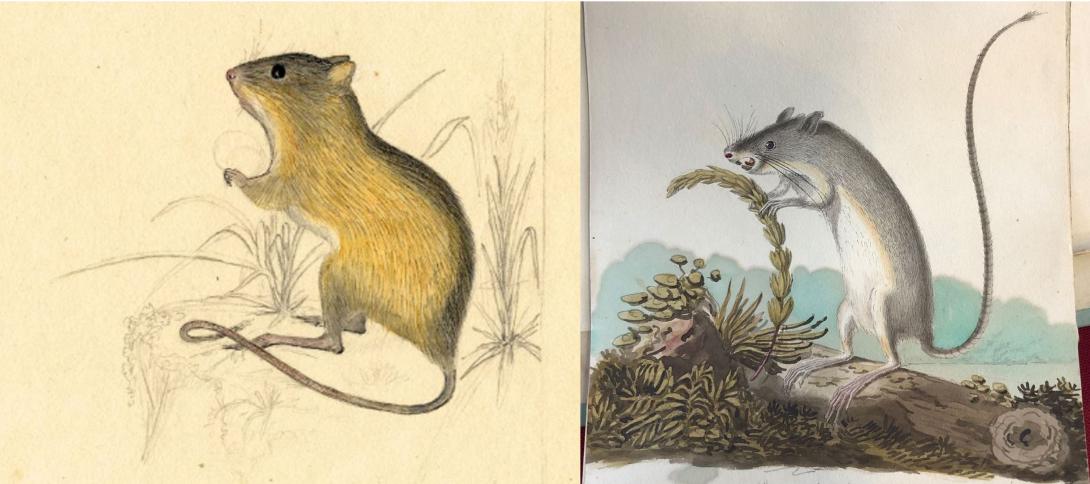
Jerboas are hopping desert rodents found throughout Arabia, Northern Africa and Asia. Zapodinae, the jumping mice, are a non-desert-dwelling dipodid relative of jerboas native to North America. The meadow jumping mouse (Zapus hudsonius) is the most widely distributed mouse in the subfamily Zapodinae and is found throughout much of North America. Titian Ramsay Peale encountered this species when accompanying the Long Expedition in 1819-1820; his watercolor is pictured here. The donor, Benjamin Smith Barton (1766-1815) was an American botanist, naturalist, and physician. He was a member of the American Philosophical Society and a Visitor of the Peale Museum.
See Benjamin Smith Barton, "Some Account of an American Species of Dipus, or Jerboa," Transactions of the American Philosophical Society 4 (1799): 114-124 / https://www.biodiversitylibrary.org/page/12181070
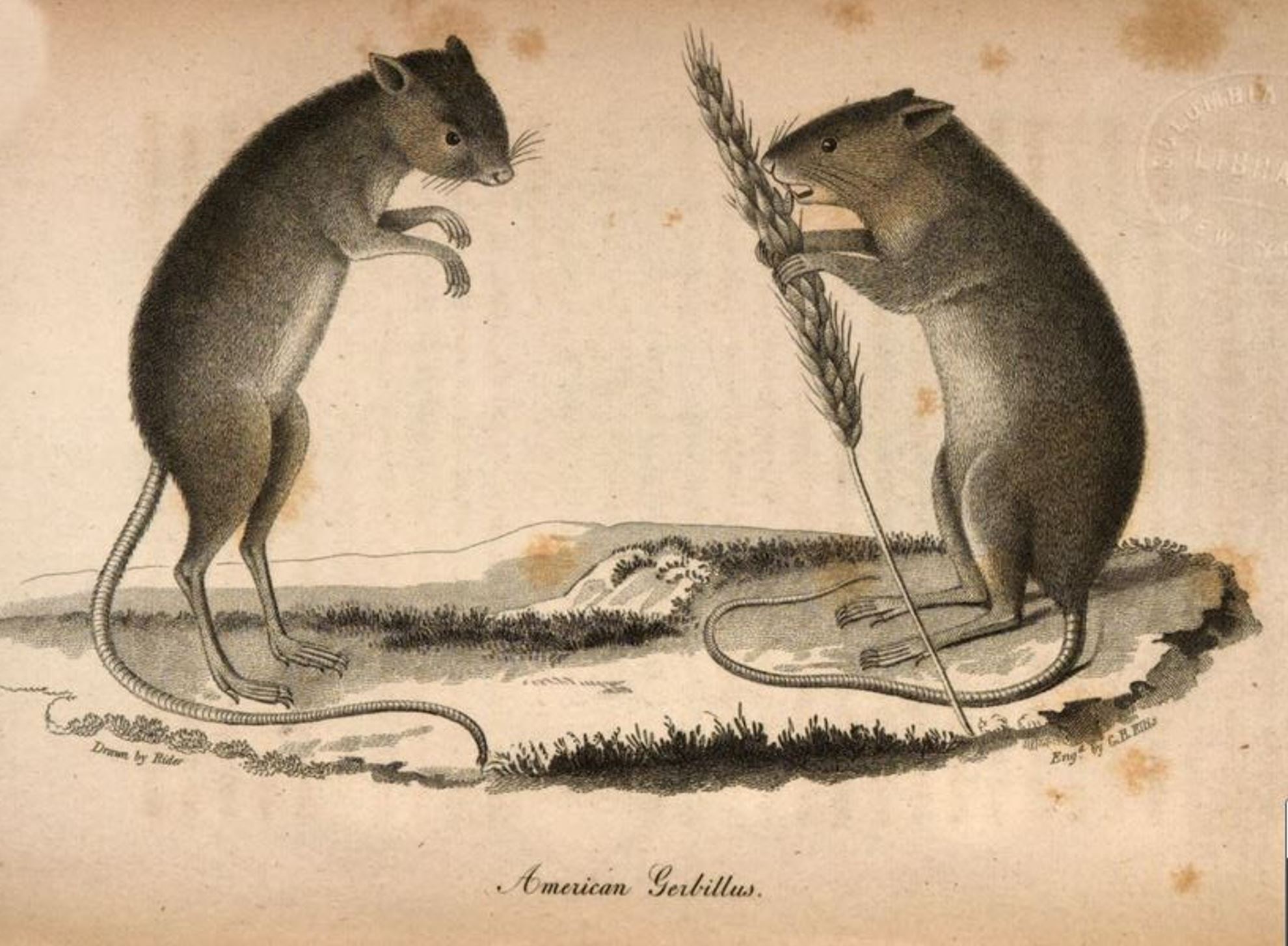
Charles Alexandre Lesueur, the French naturalist, made a watercolor drawing (pictured above) of an animal closely resembling the right-hand figure in the Rider/Godman plate. He called it “Gerbillus leonurus ? Rafines[que],” identifying it conjecturally with a species of that name described by Constantine Samuel Rafinesque in “Further Discoveries in Natural History, made during a Journey through the Western Regions of the United States," in American Monthly Magazine and Critical Review, 3, no. 6 (Oct 1818): 445-447 / https://archive.org/details/sim_american-monthly-magazine-critical-revi…. Lesueur and Rider may both have worked from a specimen in the Peale Museum, or one may have copied from the other.
Richard Harlan described this species "from a well prepared specimen in the Philadelphia Museum" in Fauna Americana: Being a Description of the Mammiferous Animals Inhabiting North America (Philadelphia, 1825), pp. 155-156 / https://www.biodiversitylibrary.org/page/3194341
John D. Godman described and illustrated this species, likely from the same specimen, in American Natural History. Part I. Mastology, 3 vols. (Philadelphia, 1826-1828), 2: 94-97 / https://hdl.handle.net/2027/nnc1.cu04828143?urlappend=%3Bseq=114%3Bowne… The plate accompanying his article is pictured here.
Specimen Type:
Dead/preserved
Peale's Common Name:
Jerbois (jumping mouse)
Current Common Name:
Meadow jumping mouse
Current Scientific Name
Zapus hudsonius
Category:
Geographic Origin:
Donor:
Collection: