Object Status:
Unlocated
Accession Date:
December 28, 1809
Primary Source Reference:
Peale Museum Accessions Book, Historical Society of Pennsylvania, p. 43
Additional Source Text:
This artifact appears on a long list of "Articles collected by Meriwether Lewis Esqr. and William Clark Esq. in their voyage and Journey of Discovery, up the Missouri to its source and to the Pacific Ocean, presented at different periods, through the president of the United States, Thomas Jefferson."
Notes:
Meriwether Lewis (1774-1809) and William Clark (1770-1838) undertook their western Expedition in 1804-1806.
The Peale Museum recorded receiving other tobacco pouches from Lewis and Clark on this same list. One was "from the Raneird's or Foxes"; one was "from the Ioway's"; and one was "not ornimented sent by the Sacks."
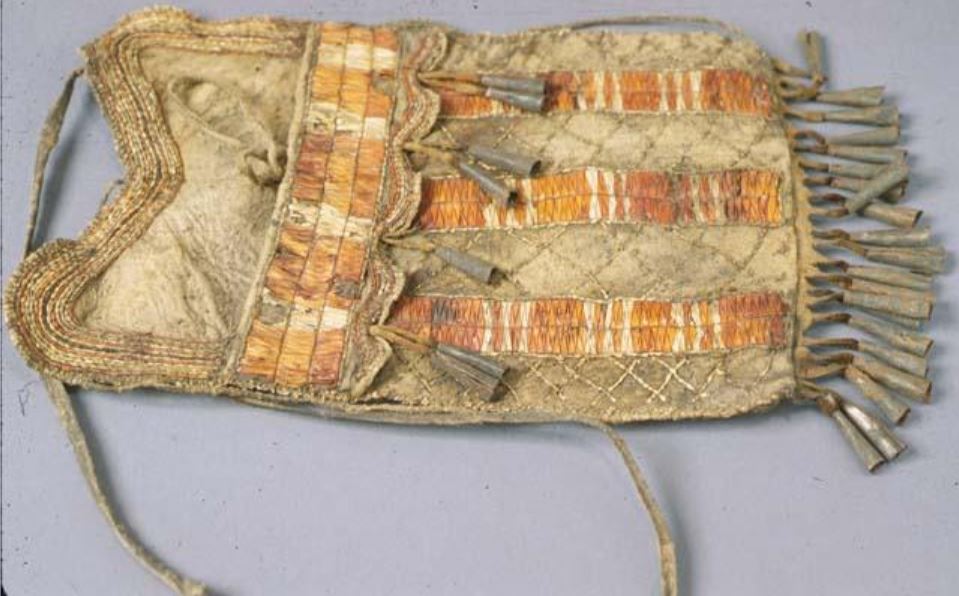
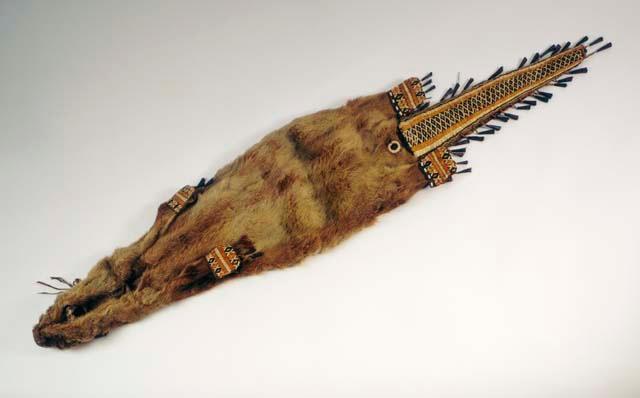
None of these pouches has been positively identified with any extant artifact, but the Peabody Museum of Archaeology and Ethnology, Harvard University, acquired several in 1899, variously called otter bags, quilled pouches, shot bags, or tobacco pouches, that were quite possibly once in the Peale Museum. Two are pictured here (Object numbers 99-12-10/53072 and 99-12-10/53073). (One of these could also have been the one donated by Baltus Raser on 3 Sep 1814 (see the entry "Tobacco-pouch, made of the Otter Skins, also orniminted.") The Du Simitière museum also had one, donated by Gen. James Wilkinson (see the entry "An Indian tobacco pouch of leather, the lower part ornamented with an embroidery of porcupine Quills.") Castle McLaughlin, The Arts of Diplomacy: Lewis & Clark's Indian Collection (Seattle, 2003), pp. 86-92
In his "Walk through the Philad[elphi]a Museum" (1805-1806), pp. 27-28, Peale wrote: "These quills variously dyed, are used by the aborigenes of America to ornament their dresses &c. and although short, are more dangerous than the long ones of the crested Porcupine, for they are barbed whereas the points of the others are smooth."pp. 27-28) Peale wrote of porcupine quills: "These quills variously dyed, are used by the aborigenes of America to ornament their dresses &c. and although short, are more dangerous than the long ones of the crested Porcupine, for they are barbed whereas the points of the others are smooth."
John D. Godman, in his American Natural History. Part I. Mastology, 3 vols. (Philadelphia, 1826-1828), 2: 153-154, described one of the methods Native Americans used to ornament their clothing, based on the large collection of such items in the Museum / https://www.biodiversitylibrary.org/page/49165857
Category:
Geographic Origin:
Collection: