Object Status:
Unlocated
Accession Date:
By February 1796
Primary Source Reference:
Palisot de Beuavois, "Description of a New Animal, found in a Swamp in Jersey, near the Delaware," Transactions of the American Philosophical Society, 4 (1799): 279-281 / https://archive.org/details/jstor-1005106/page/n3/mode/2up
Additional Source Text:
"Read February 19, 1796"
"Mr. Peale has preserved the . . . animal alive in water for nearly thirty six hours, at the end of which time it died. He observed, that as long as it lived it continued swimming, making use of its feet and principally of its tail; that the lobes which terminate the gills were continually floating and in motion."
Notes:
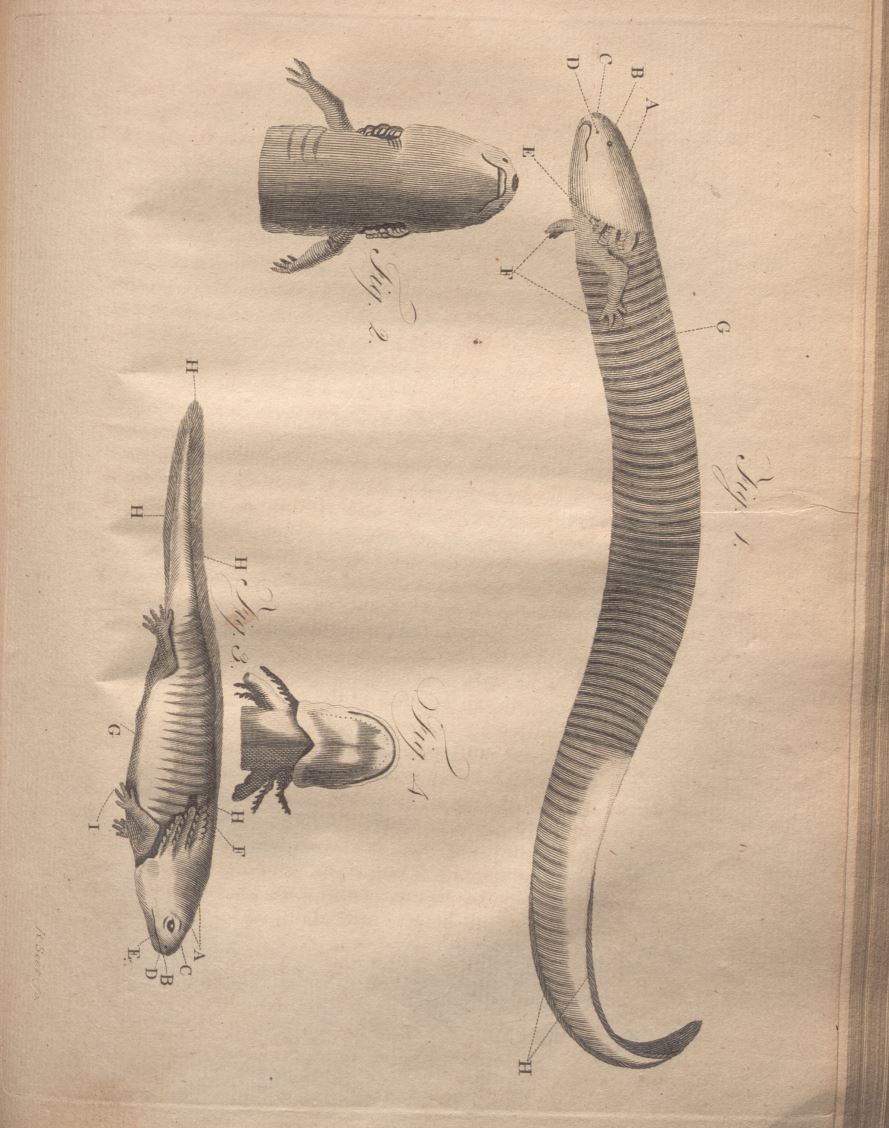
Palisot de Beauvois named this specimen Siren operculata and described it in his and Peale's name in the paper he read at a meeting of the American Philosophical Society on 19 Feb 1796. "Translation of a Memoir on a new Species of Siren," Transactions of the American Philosophical Society, 4 (1799): 279-281 and plate. The paper includes both a "Description of the Inguana, Called Mud Inguana by the Americans, Sirena lacertina by Linnaeus, and Muræna Siren by Gmelin" and a "Description of a New Animal, found in a Swamp in Jersey near the Delaware," not very distant from the Middle Ferry opposite the City of Philadelphia" / https://archive.org/details/jstor-1005106/page/n1/mode/2up
In the plate, pictured here, the mud inguana is depicted in Figs. 1 and 2, the Siren operculata in Figs. 3 and 4.
Charles Willson Peale wrote to Thomas Tims on 10 June 1796: "I have a few years back found in the neighbourhood of Philada. an Animal much resembling the Mud Inguana, especially about the head -- but it has four feet, it is intirely new an[d] undescribed as far as I have yet been able to search amongst Authors on Natural history. . . . This was found swimming in stagnant water." Selected Papers, 2, part 1: 149-151
For similar animals acquired by the Peale Museum, search "Siren."
Specimen Type:
Live/living (presumably eventually taxidermied/preserved)
Peale's Scientific Name:
Siren operculata (Palisot de Beauvois's name)
Current Common Name:
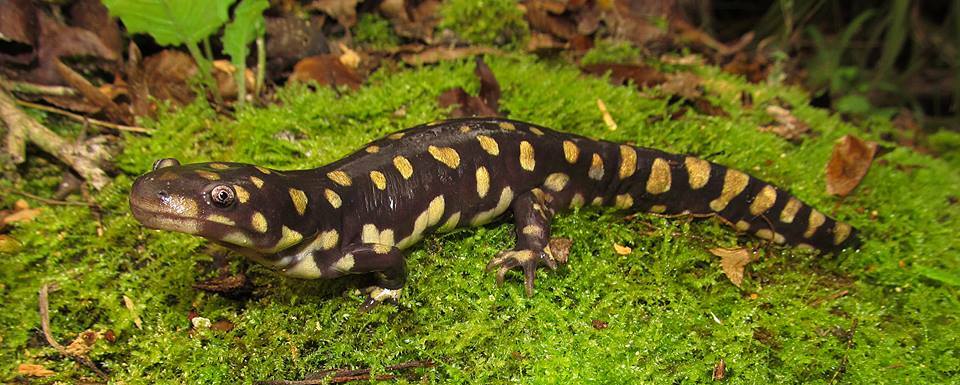
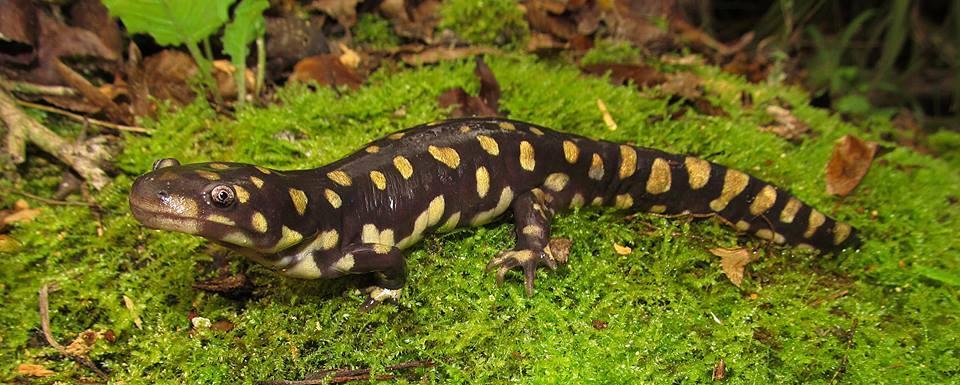
Tiger salamander
Current Scientific Name
Ambystoma tigrinum