Object Status:
Unlocated
Accession Date:
November 1779
Primary Source Reference:
Du Simitière Memorandum Books, Library of Congress, fol. 50v
Additional Source Text:
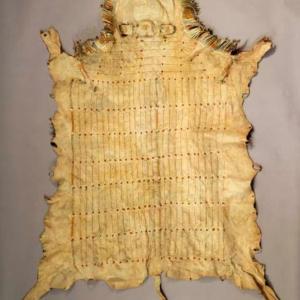
"With a mouth painted red, the eyes of yellow copper, with a round hole in the middle to peep thro' the forehead covered with a piece of bear Skin by the way of a cap. Found with several more to the number of about 40, in an Indian town call'd Chemung [N.Y.] which was burn't by the contl army under Gen. Sullivan in his expedition last Summer into the country of the Six Nations, these vizors are commonly call'd Manetoe-faces [manitou masks] & serve for the Indian conjurors or Pawaws in their dances & other ceremonies, there is also a long horse tail that belonged to it with a coat of bear skins, but this was destroyed by the Soldiery. NB all these masks were different from each other."
"Given by Wilson of the continental hospital at the recommendation of Gen. Mifflin & Dr. Jon. Potts."
Notes:
John Sullivan (1740-1795) was an Irish-American general in the Revolutionary War, a delegate in the Continental Congress, Governor of New Hampshire, and a judge in the U.S. District Court for the District of New Hampshire. As a major general in the Continental Army, he commanded the Sullivan Expedition in 1779, a scorched earth campaign against the Iroquois towns that had taken up arms against the American revolutionaries.
Dr. Goodwin Wilson (d. 1799) was a surgeon who later became director of the Continental medical department in Virginia.
Thomas Mifflin (1744-1800), was an American merchant, soldier, and politician from Philadelphia. He was the first Governor of Pennsylvania (1790 to 1799).
Dr. Jonathan Potts (1745-1781) was medical director-general of the Northern Department of the Continental Army during the Revolution. He studied medicine in Philadelphia (under Dr. Thomas Bond) and Edinburgh, Scotland (with Benjamin Rush). In 1768 he was part of the first class of medical students to be graduated from the College of Philadelphia.