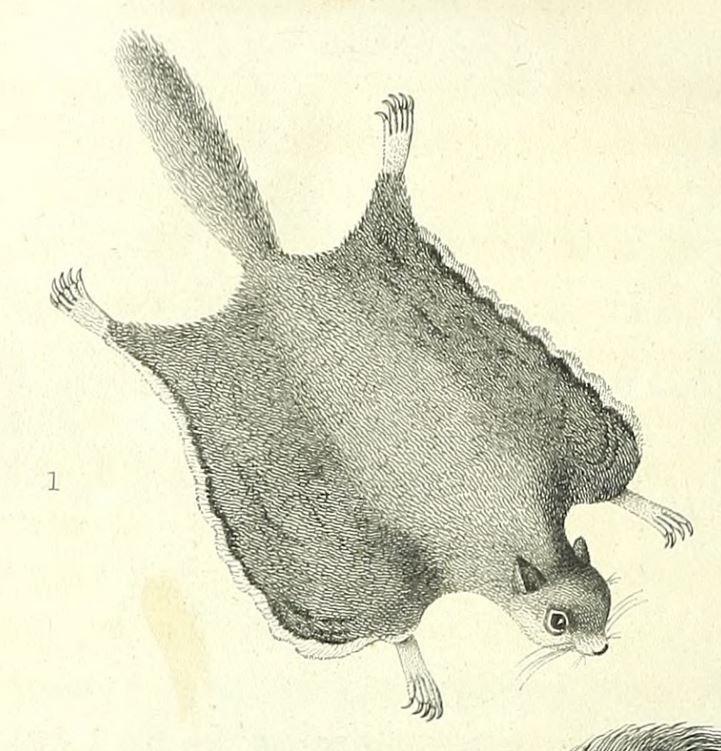
Object Status:
Unlocated
Accession Date:
By 1799
Primary Source Reference:
Natural History Lecture No. 8 (1799), Academy of Natural Sciences of Drexel University
Additional Source Text:
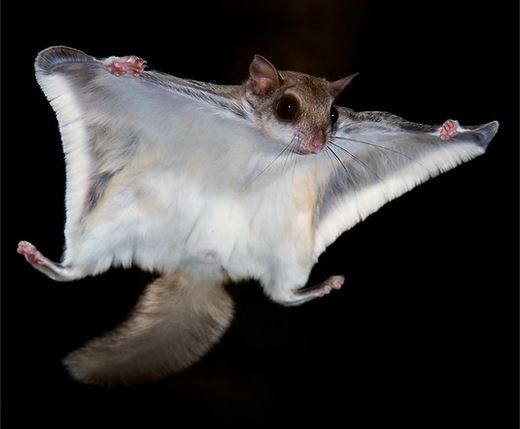
"The upper part of this Animal is covered with a soft coat of grey hairs, the under parts of a shining white, and a flat tail; one in this case is tipped with white. They have a small bone which extends at right angles from each of the fore feet, for the purpose of stretching out the skin, which skin serves it as wings reaching from the Fore to the hind legs."
In his "Walk through the Phil[adelphi]a Museum" (1805-1806), pp. 33-34, Peale wrote: "That beautiful flying Squirrel reminds us how much Authors have been mistaken about its flights. They say that it only sails from a higher Tree or branch to one lower, and cannot fly like the Birds or Bats. We submit to the latter, but it is a fact that they can fly in a horizontal line for a considerable distance & then assend several feet to light on a tree. This they will do when frightened from their holes in old trees. If the tree where they breed is struck with any thing of sufficient weight to give the tree a tremalous motion, they will in a fright leave their holes, and make a flight of 30 or 40 yards to other Trees."
Notes:
Flying squirrels (scientifically known as Pteromyini or Petauristini) are a tribe of 50 species of squirrels in the family Sciuridae. They are not capable of flight in the same way as birds or bats but are able to glide from one tree to another with the aid of a patagium, a furry, parachute-like membrane that stretches from wrist to ankle. Their long tails provide stability in flight.
John D. Godman described the flying squirrel (possibly based on the specimen in the Museum) in American Natural History. Part I. Mastology, 3 vols. (Philadelphia, 1826-1828), 2: 146-148 / https://hdl.handle.net/2027/dul1.ark:/13960/t3wt2j207?urlappend=%3Bseq=…. A detail from the accompanying plate is pictured here.
Three species of the genus Glaucomys are native to North America, only one of which -- the southern flying squirrel (Glaucomys volans) is found in the eastern United States, and it is pictured here.
On November 19, 1813 the Museum received "A Living White Flying Squirrel, from the City of Washington" from Mariner William Stretcher. Peale Museum Accessions Book, Historical Society of Pennsylvania, p. 70
Specimen Type:
Dead/preserved
Peale's Common Name:
Flying squirrel
Peale's Scientific Name:
Sciurus Volucella
Current Common Name:
Southern flying squirrel
Current Scientific Name
Glaucomys volans